How Iran has damaged the US military footprint in the Middle East (PHOTOS, VIDEOS)
Evidence on the damage inflicted to US military facilities in the Gulf during the war with Iran continues emerge, with Washington having acknowledged that facilities were hit across multiple countries. While the latest media figures say that at least 16 American bases in the region were struck, the Pentagon is apparently doing its best to conceal the destruction.
Within hours of the US launching ‘Operation Epic Fury’ on February 28, Iran unleashed retaliatory strikes against American military bases across the Middle East, with US officials confirming a growing number of sites hit and the Prince Sultan base in Saudi Arabia emerging as a focal point of the campaign.
Behind a veil of censorship, it’s increasingly clear that the damage may be far more severe than the Pentagon has admitted.
US leadership downplaying scope of destruction
In a report to a Congressional committee on Wednesday, senior Pentagon official Jules Hurst estimated that the war had cost Washington around $25 billion, most of this allegedly in expended munitions. War Secretary Pete Hegseth later refused to say whether the figure included repair costs to US bases.

Lawmakers have already blasted the estimate, calling it unrealistic in light of the Pentagon’s early reports, which said the war had cost around $11 billion in just the first six days.
However, the true price tag of the conflict is reportedly far higher. Factoring in the expense of repairing damaged US military facilities, the figure could be closer to $40-50 billion, CNN has reported, citing anonymous sources.
Iran’s retaliation for the initial attack saw it hit dozens of targets across US facilities in eight Middle Eastern nations, CNN has said. Warehouses, command headquarters, aircraft hangars, satellite communications infrastructure, runways, high-end radar systems and dozens of aircraft were reportedly struck.
In the early days of the conflict, an Iranian F-5 fighter jet bombed Camp Buehring in Kuwait, marking the first time in many years that a US base was struck by an enemy fixed-wing aircraft, according to the officials.
Washington delays release of satellite images
In mid-March, California-based Planet Labs company, which provides access to satellite imagery to government and business, extended delaying releasing satellite images of the damage to 14 days to preclude the use by “adversarial actors.”
On April 5, Bloomberg reported that the Trump administration had asked the company, along with several others working in the sector, to “voluntarily withhold images of designated areas of interest due to the ongoing conflict in the Middle East.” Some of Planet Labs’ images shared online exposed damage to US military sites.
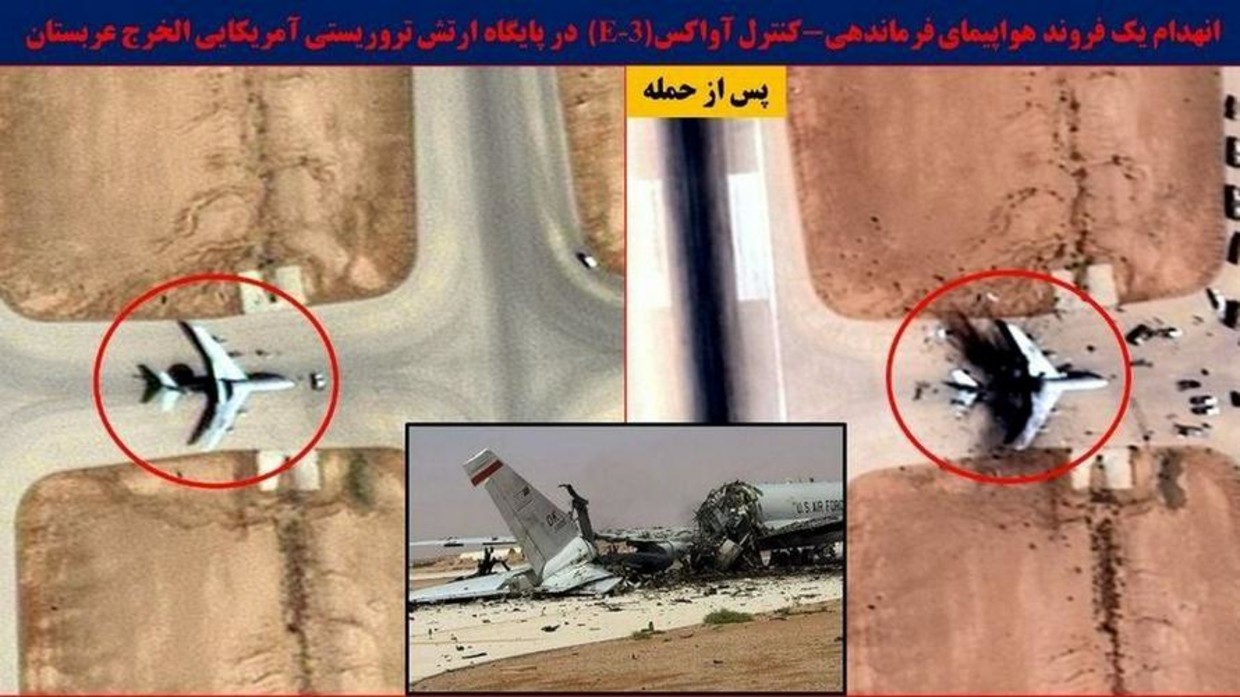
The reported damage to high-value assets such as an E-3 AWACS aircraft and an F-35 fighter jet points to a broader pattern of Iran targeting US airpower and surveillance capabilities. An E-3 Sentry was reportedly damaged or destroyed in a March 27 strike on Prince Sultan Air Base. Earlier, a US F-35 was damaged during a mission over Iran and forced to make an emergency landing, while three US F-15E jets were shot down over Kuwait on March 2 in an apparent friendly fire incident, US Central Command (CENTCOM) said

The US death toll has continued to rise since February. The US military has confirmed 13 fatalities from Iranian attacks across the region, while more than 400 troops have been wounded, according to numbers cited in Congress.
New strikes and expanding damage
Iran continued to expand the scope of its attacks during the active phase of the conflict. Iranian military statements carried by local media named targets including Camp Arifjan in Kuwait, Prince Sultan Air Base near Al-Kharj in Saudi Arabia, and Sheikh Isa Air Base in Bahrain, while also referring more broadly to strikes on US positions in Iraq, the UAE, and across the Gulf. Iran’s Islamic Revolutionary Guard Corps (IRGC) also claimed it had targeted the US Fifth Fleet and destroyed “high-value” American military equipment.
The Iranian strikes nearly wiped out US long-range radar and communications equipment in the region, taking out all but one American regional radome in less than a month into the conflict, a CNN investigation concluded on Friday. The massive, hardened dome structures house sophisticated long-range radar and satellite communications equipment, and provide a key backbone to the US interception capabilities in the region. Some units are valued upward of a billion dollars.
A March 27 Iranian missile and drone strike on Prince Sultan Air Base in Saudi Arabia wounded 12 US troops, two of them seriously, according to a US official cited by Reuters. The attack also damaged several US aircraft, according to American officials, with separate reports indicating that refueling planes were among those hit.
US and Arab officials cited by the Wall Street Journal said the same strike also hit a Boeing E-3 Sentry airborne warning and control system (AWACS) aircraft, a critical surveillance platform. The IRGC said the aircraft was “100% destroyed” in the strike, while open-source flight tracking data indicated that several such planes had been stationed at the base in recent weeks. The E-3, a key command-and-control platform, costs around $270 million to produce. CENTCOM has not publicly confirmed the extent of the reported damage.
Iranian media has also claimed drone and rocket strikes on US-linked facilities in Iraq, including targets around Baghdad and the Victory Base complex. Reuters has reported a drone strike on a US diplomatic facility near Baghdad airport on March 10, followed by further rocket and drone attacks on March 17.
At least 16 US military installations across eight Middle Eastern nations have been damaged, some being left “virtually unusable,” a CNN investigation concluded on Friday. Iran’s “rapid, targeted strikes using advanced technology” were unlike anything previously faced by American military bases, the report said, citing a source familiar with the matter.
How many bases does the US have in the Middle East?
The US operates a network of around 20 permanent and temporary military bases throughout the Middle East, with the largest – Al Udeid Air Base in Qatar – hosting 10,000 troops and serving as the forward headquarters for CENTCOM. The US maintains a network of major military bases across Bahrain, Egypt, Iraq, Jordan, Kuwait, Qatar, Saudi Arabia, and the United Arab Emirates, and as of mid-2025, there are between 40,000 and 50,000 American troops stationed in the region at any one time.
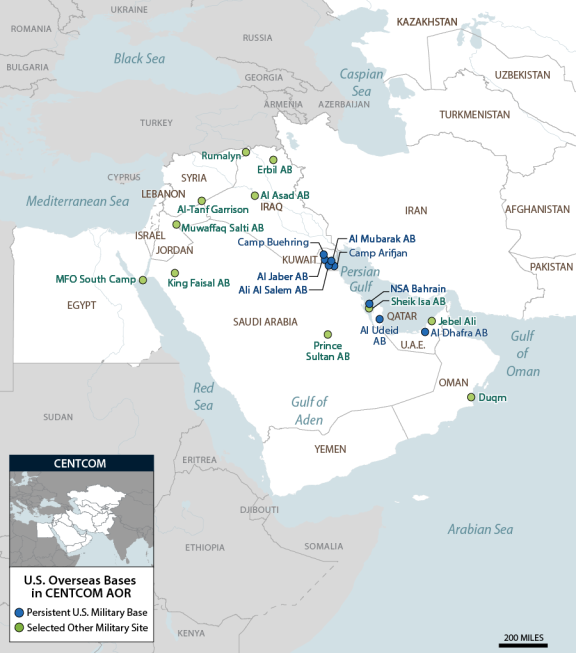
These bases surround Iran from the west and south and are backed by US naval assets in the region, including the USS Abraham Lincoln in the Arabian Sea, alongside amphibious forces in the region, including the USS Tripoli, with additional carrier reinforcements expected. The USS Gerald R. Ford has been pulled out of the Middle East and moved to port for repairs following a fire, leaving the Lincoln as the only carrier currently on station.

Recent deployments have further expanded the US military footprint in the region. The arrival of around 2,500 marines and 2,500 sailors has pushed the total number of American troops in the Middle East to more than 50,000, roughly 10,000 above typical levels, according to a US military official cited by the New York Times.
Which US bases have been hit?
All of the US bases in the region have been described as “legitimate targets” by the Iranian military, and facilities in seven countries were hit by Iranian missiles and drones.
As of late March, the following US bases and associated facilities had been struck by Iranian missiles and drones, often more than once, according to US officials, media reports, and regional sources:
- Naval Support Activity, Bahrain
- Erbil International Airport, Iraq
- Al-Asad Airbase, Iraq
- Victory Base complex (Baghdad International Airport area)
- Muwaffaq Salti Air Base, Jordan
- Ali Al-Salem Air Base, Kuwait
- Camp Buehring, Kuwait
- Camp Arifjan, Kuwait
- Mohammed Al-Ahmad Naval Base, Kuwait
- Al-Udeid Air Base, Qatar
- Al-Dhafra Air Base, UAE
- Jebel Ali Port, UAE
- Prince Sultan Air Base, Saudi Arabia.
Several of these strikes have been confirmed by US officials or reported by Reuters and other international media, while others remain based primarily on Iranian claims.
How has Washington’s inability to protect Gulf allies affected their relationship?
On top of the strikes Iran carried out on Washington’s military facilities in Gulf nations, Tehran has successfully struck oil and gas infrastructure, as well as multiple buildings it claimed were housing American soldiers.
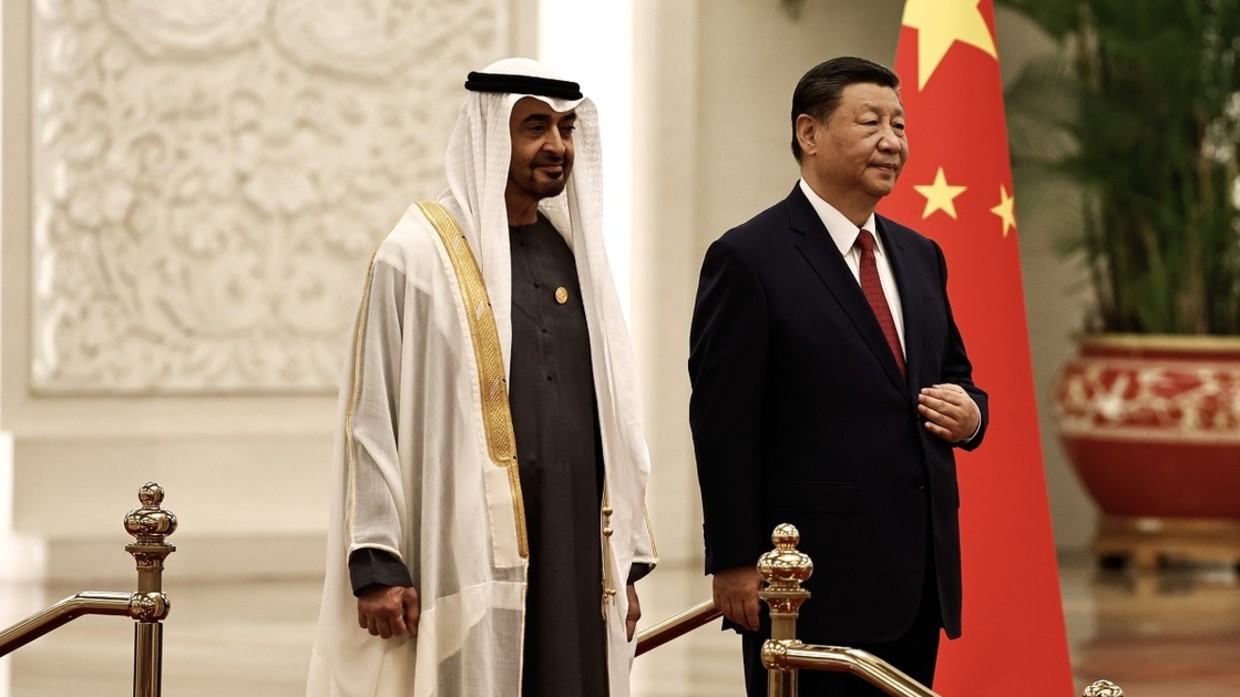
The illusion that a US base on a nation’s territory would provide it a protective umbrella has been cracked, with Gulf nations reportedly beginning to hedge their bets and looking elsewhere for potential allies.
“The alliance with the US cannot be exclusive and it is not… impregnable,” CNN cited a Saudi source as saying on Friday.
Gulf nations are also suffering with their main export – fossil fuels – being locked into the Strait of Hormuz by Iran’s blockade and the US blockade of Iranian ports. The UAE has reportedly warned the US Treasury that it could be forced to trade oil in Chinese yuan to compensate.


