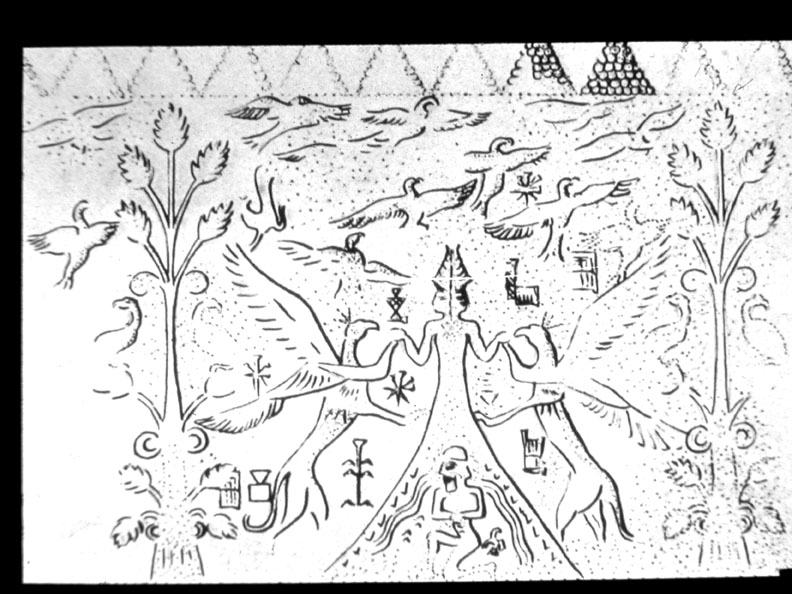
مهر استوانهای، استوانهای گرد و کوچک است که معمولاً حدود یک اینچ (2 تا 3 سانتیمتر) عرض دارد و با حروف نوشتاری یا صحنههای تصویری یا هر دو حکاکی شده است و در دوران باستان برای غلتاندن یک نقش روی یک سطح دو بعدی، عموماً خاک رس مرطوب، استفاده میشد. طبق برخی منابع، مهرهای استوانهای حدود 3500 سال قبل از میلاد در خاور نزدیک، در مکانهای معاصر اوروک در جنوب بینالنهرین و کمی بعدتر در شوش در جنوب غربی ایران در دوره پروتو-ایلامی اختراع شدند و از توسعه مهرهای مهری در فرهنگ حلف یا کمی قبلتر از آن پیروی میکنند.[4] آنها با اختراع خط میخی روی لوحهای گلی مرتبط هستند.[5][6]
مهرهای استوانهای نوعی مهر مهری هستند، دستهای که شامل مهر مهری و مهر انگشتری میشود. آنها به تعداد نسبتاً زیادی باقی ماندهاند و به عنوان هنر، به ویژه در دورههای بابلی و آشوری اولیه، اهمیت دارند. نقشها را میتوان بدون خطر آسیب به مهر، روی یک ماده نرم ایجاد کرد و اغلب در موزهها همراه با یک نقش مدرن روی یک نوار کوچک به نمایش گذاشته میشوند. مواد
خود مهرهای استوانهای معمولاً از سنگهای سخت ساخته میشوند و برخی از آنها نوعی گوهر حکاکی شده هستند. همچنین ممکن است از شیشه یا سرامیک، مانند سفال مصری، استفاده شود. انواع مختلفی از مواد مانند هماتیت، ابسیدین، استئاتیت، آمتیست، لاجورد و کارنلین برای ساخت مهرهای استوانهای استفاده میشد. از آنجایی که کشور آبرفتی بینالنهرین فاقد سنگ خوب برای حکاکی است، سنگهای بزرگ استوانههای اولیه احتمالاً از ایران وارد میشدند.[7] اکثر مهرها دارای سوراخی در مرکز بدنه هستند و تصور میشود که معمولاً روی گردنبند پوشیده میشدند تا در صورت نیاز همیشه در دسترس باشند.
مقایسه اندازه مهرها، به همراه نوارهای نقش آنها
(نقشهای مدرن/فعلی)
کاربردها
نقشهای مهر استوانهای به عنوان یک ابزار اداری، نوعی امضا،[8] و برای برندسازی محصول استفاده میشدند.[9] خود استوانهها به عنوان جواهرات و طلسمهای جادویی عمل میکردند؛[10] نسخههای بعدی [چه زمانی؟] از نمادگذاری با خط میخی بینالنهرین استفاده میکردند. در دورههای بعدی، از آنها [نیازمند منبع] برای ثبت یا گواهی چندین اثر از اسناد گلی استفاده میشد. گورها و سایر مکانهایی که اقلام گرانبهایی مانند طلا، نقره، مهرهها و سنگهای قیمتی در آنها نگهداری میشد، اغلب شامل یک یا دو مهر استوانهای، به عنوان کالاهای تدفینی افتخاری، بودند.
بیشتر مهرهای استوانهای بینالنهرین با استفاده از فرورفتگیهایی در سطح استوانه (به عکس سربی بالا مراجعه کنید) تصویری را تشکیل میدهند تا برآمدگیهایی روی اثر ایجاد کنند و عمدتاً روی خاک رس مرطوب استفاده میشوند. اما برخی از مهرهای استوانهای (که گاهی اوقات مهرهای غلتکی نامیده میشوند) تصاویر را با استفاده از جوهر یا موارد مشابه با استفاده از نواحی برجسته روی استوانه چاپ میکنند (مانند مهر استوانهای سن آندرس که نه در بینالنهرین، بلکه در یک سایت باستانشناسی اولمک در ایالت تاباسکو مکزیک امروزی یافت میشود) و تصاویری را روی پارچه و سایر سطوح دو بعدی مشابه ایجاد میکنند.
اثر مهرهای استوانهای روی سطوح مختلفی ظاهر میشوند:
طلسمها
بستههای کالا
آجرها
لوحهای سفالی
پارچه
اجزای اشیاء ساخته شده
درها
پاکتها
ظروف نگهداری
ماهیتی موضوعمحور، یادبودی و یادبودی
این مهر استوانهای نئوآشوری، آیینی با خدایان محافظ بالدار را نشان میدهد. موزه هنر والترز.
تصاویر به تصویر کشیده شده روی مهرهای استوانهای عمدتاً موضوعمحور و اغلب جامعهشناختی یا مذهبی بودند. به جای پرداختن به اقتدار مهر، مطالعه بهتر میتواند ماهیت موضوعی مهرها باشد، زیرا آنها ایدههای جامعه را به صورت تصویری و متنی ارائه میدادند. در یک استوانه معروف که داریوش اول پارسی را به تصویر میکشد، او کمان کشیده خود را به سمت شیر خشمگین ایستادهای که با دو تیر به دار آویخته شده است، نشانه گرفته است، در حالی که اسب ارابهاش در حال لگدمال کردن شیر مردهای است. صحنه بین دو درخت نخل باریک و یک بلوک متن میخی و در بالای صحنه، نماد فروهر اهورا مزدا، نماد خدای زرتشتی، قاب گرفته شده است.
دستهبندی مهرها
سبک نگارش این بخش ممکن است منعکس کننده لحن دانشنامهای مورد استفاده در ویکیپدیا نباشد. برای پیشنهادات به راهنمای ویکیپدیا برای نوشتن مقالات بهتر مراجعه کنید. (آگوست ۲۰۲۵) (یاد بگیرید چگونه و چه زمانی این پیام را حذف کنید)
مرجع زیر، گاربینی، بسیاری از دستههای مهر استوانهای زیر را پوشش میدهد. کتاب «اولین برداشتها» اثر دومینیک کولون، که به این موضوع اختصاص دارد، بیش از ۱۰۰۰ تصویر دارد.
دستهای از مهرهای استوانهای:
مهرهای استوانهای اکدی.
مهر اکدی، حدود ۲۳۰۰ سال قبل از میلاد، مهر سنگی با نقش مدرن. به مرجع نشنال جئوگرافیک مراجعه کنید. نقش برجسته (صحنهها) «خدا را در قایق»، مردم و هدایا نشان میدهد.
مهرهای استوانهای آشوری.
مهرهای استوانهای قبرسی.
مهرهای استوانهای مصری.
مقبرهها و گورهای پیش از سلسلهای مصری دوران نقادا (وارداتی).
معرقکاری مصری؛ به لینک Pepi I ext مراجعه کنید.
مهرهای استوانهای هیتی.
استفاده از پاکت سفالی و غیره؛ به Kultepe مراجعه کنید.
کاسیت (کاسیها)، مهرهای استوانهای.
مهرهای استوانهای میتانی.
مهرهای استوانهای بابلی باستان.
مهرهای استوانهای پارسی؛ رجوع کنید به داریوش اول، مرجع رابینسون.
مهرهای استوانهای پروتو-ایلامی.
مهرهای استوانهای سومری.
مهرهای "خدای ماه"؛ رجوع کنید به سین.
رجوع کنید به مرجع (رابینسون)، مهر اور-نامو، ۲۱۱۲-۲۰۹۵ پیش از میلاد. تصویر نزدیک از مهر، و "برداشت مدرن" مجاور، با وضوح بالا، اندازه طبیعی ۲X-۳X :: رجوع کنید به https://www.britishmuseum.org/collection/object/W_1880-1009-1
"مهرهای تصویرنگاری شمش"؛ رجوع کنید به ماری، سوریه.
مهرهای استوانهای سومری نو. رجوع کنید به مرجع (گاربینی)، "خدای نشسته و پرستندگان"، مهر استوانهای، و یک برداشت مدرن، صفحه ... 40، (موزه بریتانیا، لندن).
مهرهای استوانهای سوری.
همچنین ببینید
یک نمونه از مهر استوانهای سرامیکی سن آندرس که حاوی شواهدی از قدیمیترین سیستم نوشتاری در آمریکای میانه است. این مهر استوانهای تقریباً مربوط به 650 سال قبل از میلاد است و ارتباطی با مهرهای استوانهای بینالنهرین ندارد.
آشور. مهرهایی که روش نصب را نشان میدهند؛ موزه بروکلین، بایگانی موزه بروکلین، مجموعه بایگانی گودیر
آیکون پورتال آسیا
مهرها و شیوههای مهرگذاری خاور نزدیک باستان
مهر (دستگاه)
مهر ضربی
مهر مهر
مهر LMLK
مهر خشتی
مهر اسکارابوئید
منابع
اطلاعیه موزه بریتانیا WA 121544
کرافورد، هریت (2013). دنیای سومری. روتلج. صفحه 622. شابک 9781136219115.
انسانشناسی، موزه باستانشناسی دانشگاه پنسیلوانیا و؛ هانسن، دونالد پی. پیتمن، هالی (۱۹۹۸). گنجینههایی از مقبرههای سلطنتی اور. موزه باستانشناسی UPenn. صفحه ۷۸. شابک ۹۷۸۰۹۲۴۱۷۱۵۵۰.
براون، برایان ای.؛ فلدمن، ماریان اچ. (۲۰۱۳). رویکردهای انتقادی به هنر خاور نزدیک باستان. والتر دی گرویتر. صفحه ۳۰۴. شابک ۹۷۸۱۶۱۴۵۱۰۳۵۲.
مهرهای استوانهای بینالنهرین، موزه بریتانیا
چرا مهرهای استوانهای؟ سنگهای مهر استوانهای حکاکیشده از خاور نزدیک باستان، هزاره چهارم تا اول پیش از میلاد، نوشته ادیت پورادا © ۱۹۹۳ انجمن هنر کالج، بولتن هنر، جلد ۷۵، شماره ۴ (دسامبر ۱۹۹۳)، صفحات ۵۶۳-۵۸۲، JSTOR
چرا مهرهای استوانهای؟ سنگهای مهر استوانهای حکاکیشده از خاور نزدیک باستان، هزاره چهارم تا اول پیش از میلاد، نوشته ادیت پورادا © ۱۹۹۳ انجمن هنر کالج، بولتن هنر، جلد ۷۵، شماره ۴ (دسامبر ۱۹۹۳)، صفحات ۵۶۳-۵۸۲، JSTOR
"مهرهای استوانهای باستانی". موزه باستانشناسی جانز هاپکینز. دانشگاه جانز هاپکینز. بایگانی شده از نسخه اصلی در ۳۰ ژوئن ۲۰۱۹. بازیابی شده در ۲۳ آوریل ۲۰۲۳. در سراسر بخش بزرگی از جهان خاور نزدیک باستان، از پایان هزاره چهارم پیش از میلاد تا قرن پنجم پیش از میلاد، مهرهای استوانهای هم به عنوان ابزار اداری - که تقریباً مانند امضای یک سند رسمی امروزی عمل میکنند - و هم برای علامتگذاری اموال و جلوگیری از دستکاری درها یا ظروف مهر و موم شده استفاده میشدند [...]. گرینبرگ، رافائل (۷ نوامبر ۲۰۱۹). «شهرنشینی و زوال آن در اوایل برنز II و III». باستانشناسی عصر برنز شام: از ریشههای شهری تا زوال دولتشهرها، ۳۷۰۰-۱۰۰۰ پیش از میلاد. باستانشناسی جهانی کمبریج. کمبریج: انتشارات دانشگاه کمبریج. صفحه ۹۲. شابک ۹۷۸۱۱۰۷۱۱۴۶۲. بازیابی شده در ۲۳ آوریل ۲۰۲۳. [...] نقش مهر استوانهای به طور تصادفی روی ظروف سرامیکی، به ویژه روی پیتویهای ساخته شده در منطقه، ظاهر میشد [...] نقش مهر، نشان سازنده است که برای علامتگذاری ظرف در نظر گرفته شده است [...]. «مهرهای استوانهای باستانی». موزه باستانشناسی جانز هاپکینز. دانشگاه جانز هاپکینز. بایگانی شده از تاریخ
//////////////////////
A cylinder seal is a small round cylinder, typically about one inch (2 to 3 cm) in width, engraved with written characters or figurative scenes or both, used in ancient times to roll an impression onto a two-dimensional surface, generally wet clay. According to some sources, cylinder seals were invented around 3500 BC in the Near East, at the contemporary sites of Uruk in southern Mesopotamia and slightly later at Susa in south-western Iran during the Proto-Elamite period, and they follow the development of stamp seals in the Halaf culture or slightly earlier.[4] They are linked to the invention of the latter's cuneiform writing on clay tablets.[5][6]
Cylinder seals are a form of impression seal, a category which includes the stamp seal and finger ring seal. They survive in fairly large numbers and are important as art, especially in the Babylonian and earlier Assyrian periods. Impressions into a soft material can be taken without risk of damage to the seal, and they are often displayed in museums together with a modern impression on a small strip.
Materials
The cylinder seals themselves are typically made from hardstones, and some are a form of engraved gem. They may also use glass or ceramics, like Egyptian faience. Many varieties of material such as hematite, obsidian, steatite, amethyst, lapis lazuli and carnelian were used to make cylinder seals. As the alluvial country of Mesopotamia lacks good stone for carving, the large stones of early cylinders were imported probably from Iran.[7] Most seals have a hole running through the centre of the body, and they are thought to have typically been worn on a necklace to be always available when needed.
.jpg)
(modern/current impressions)
Uses
Cylinder-seal impressions served as an administrative tool, a form of signature,[8] and for product branding.[9] The cylinders themselves functioned as jewelry and as magical amulets;[10] later versions[when?] would employ notations with Mesopotamian cuneiform. In later periods, they were used[citation needed] to notarize or attest to multiple impressions of clay documents. Graves and other sites housing precious items such as gold, silver, beads, and gemstones often included one or two cylinder seals, as honorific grave goods.
Most Mesopotamian cylinder seals form an image using depressions in the cylinder surface (see lead photo above) to make bumps on the impression and are used primarily on wet clay; but some cylinder seals (sometimes called roller stamps) print images using ink or similar using raised areas on the cylinder (such as the San Andrés cylinder seal, found not in Mesopotamia but in an Olmec archaeological site in the present-day Mexican state of Tabasco) and produce images on cloth and other similar two-dimensional surfaces.
Cylinder seal impressions appear on a variety of surfaces:
- amulets
- bales of commodities
- bricks
- clay tablets
- cloth
- components of fabricated objects
- doors
- envelopes
- storage jars

Theme-driven, memorial, and commemorative nature

The images depicted on cylinder seals were mostly theme-driven and often sociological or religious. Instead of addressing the authority of the seal, a better study may be of the thematic nature of the seals, since they presented the ideas of the society in pictographic and text form. In a famous cylinder depicting Darius I of Persia, he is aiming his drawn bow at an upright enraged lion impaled by two arrows, while his chariot horse is trampling a dead lion. The scene is framed between two slim palm trees and a block of cuneiform text and, above the scene, the Faravahar symbol of Ahura Mazda, the god representation of Zoroastrianism.
Categories of seals
 | This section's style of writing may not reflect the encyclopedic tone used on Wikipedia. (August 2025) |
The reference below, Garbini, covers many of the following categories of cylinder seal. Dominique Collon's book First Impressions, which is dedicated to the topic, has over 1000 illustrations.
A categorization of cylinder seals:
See also


.svg)
References
- British Museum notice WA 121544
- Crawford, Harriet (2013). The Sumerian World. Routledge. p. 622. ISBN 9781136219115.
- Anthropology, University of Pennsylvania Museum of Archaeology and; Hansen, Donald P.; Pittman, Holly (1998). Treasures from the Royal Tombs of Ur. UPenn Museum of Archaeology. p. 78. ISBN 9780924171550.
- Brown, Brian A.; Feldman, Marian H. (2013). Critical Approaches to Ancient Near Eastern Art. Walter de Gruyter. p. 304. ISBN 9781614510352.
- Mesopotamian cylinder seals, British Museum
- Why Cylinder Seals? Engraved Cylindrical Seal Stones of the Ancient Near East, Fourth to First Millennium B.C., by Edith Porada © 1993 College Art Association., The Art Bulletin, Vol. 75, No. 4 (Dec., 1993), pp. 563-582, JSTOR
- Why Cylinder Seals? Engraved Cylindrical Seal Stones of the Ancient Near East, Fourth to First Millennium B.C., by Edith Porada © 1993 College Art Association., The Art Bulletin, Vol. 75, No. 4 (Dec., 1993), pp. 563-582, JSTOR
- "Ancient Cylinder Seals". Johns Hopkins Archaeological Museum. Johns Hopkins University. Archived from the original on 30 June 2019. Retrieved 23 April 2023.
Throughout much of the ancient Near Eastern world, from the end of the 4th millennium B.C.E. until the 5th century B.C.E., cylinder seals were used both as administrative tools – functioning much as a signature does on an official document today, or used to mark one's property and to prevent tampering with sealed doors or containers [...].
- Greenberg, Raphael (7 November 2019). "Urbanism and Its Demise in the Early Bronze II and III". The Archaeology of the Bronze Age Levant: From Urban Origins to the Demise of City-States, 3700-1000 BCE. Cambridge World Archaeology. Cambridge: Cambridge University Press. p. 92. ISBN 9781107111462. Retrieved 23 April 2023.
[...] cylinder-seal impressions appeared randomly on ceramic vessels, especially on pithoi manufactured in the region [...] the seal-impression is the mark of the fabricant, intended to brand the vessel [...].
- "Ancient Cylinder Seals". Johns Hopkins Archaeological Museum. Johns Hopkins University. Archived from the original on 30 June 2019. Retrieved 23 April 2023.
Throughout much of the ancient Near Eastern world, from the end of the 4th millennium B.C.E. until the 5th century B.C.E., cylinder seals were used [...] as decorative or protective amulets – often worn on a necklace or a pin.
- "Cylinder Seal with a Nude Goddess". The Walters Art Museum.
Further reading
- Bahn, Paul. Lost Treasures, Great Discoveries in World Archaeology, Ed. by Paul G. Bahn, (Barnes and Noble Books, New York), c 1999. Examples of, or discussions of Stamp seals, cylinder seals and a metal stamp seal.
- Collon, Dominique. First Impressions, Cylinder Seals in the Ancient Near East, (British Museum Press, London), 1987, 2005. Very comprehensive and up to date account, with many illustrations. The author has compiled several of the volumes cataloging the collection of cylinder seals in the British Museum.
- Collon, Dominique. Near Eastern Seals, (British Museum, London), 1990. Shorter account which also includes stamp seals . Part of the BM's Interpreting the Past series
- Frankfort, H. Cylinder Seals, 1939, London. A classic, though obviously does not reflect later research.
- Garbini, Giovanni. Landmarks of the World's Art, The Ancient World, by Giovanni Garbini, (McGraw-Hill Book Company, New York, Toronto), General Eds, Bernard S. Myers, New York, Trewin Copplestone, London, c 1966. "Discussion, or pictures of about 25 cylinder seals"; also lists the "Scaraboid seal", an impression seal (needs to be a mirror/reverse to be an impression seal).
- Kelley, David H., "A Cylinder Seal from Tlatilco", American Antiquity, vol. 31, no. 5, pp. 744–46, 1966
- Metropolitan Museum of Art. Cuneiform Texts in the Metropolitan Museum of Art: Tablets, Cones, and Bricks of the Third and Second Millennia B.C., vol. 1 (New York, 1988). The final section (Bricks) of the book concerns cylinder Seals, with a foreword describing the purpose of the section as to instigate Research into cylinder Seals. The 'cylinder sealing' on the bricks was done multiple times per brick. Some are of high quality, and some are not. (Also contains the only 2 el Amarna letters, in the US, with Analysis.)
- Metropolitan Museum of Art. Ancient Near Eastern Art, (Reprint), Metr. Mus. of Art Photograph Studio, Designed, Alvin Grossman, Photography, Lynton Gardiner, (Metropolitan Museum of Art Bulletin (Spring 1984)), c 1984. 56pgs.
- Metropolitan Museum of Art. Beyond Babylon, Art, Trade and Diplomacy in the Second Millennium BC, ed. Joan Aruz. 2008. Many cylinder seals of the period illustrated in color with impress=ions and descriptions.
- National Geogr. Soc. Wonders of the Ancient World; National Geographic Atlas of Archeology, Norman Hammond, Consultant, Nat'l Geogr. Soc., (Multiple Staff authors), (Nat'l Geogr., R.H.Donnelley & Sons, Willard, OH), 1994, 1999, Reg. or Deluxe Ed. Origins of Writing, section, pp 68–75. Akkadian Cylinder seal, with its modern seal impression. p. 71.
- Robinson, Andrew. The Story of Writing, Andrew Robinson, (Thames and Hudson), c 1995, paperback ed., c 1999. (Page 70, Chapter 4: Cuneiform) Ur-Nammu cylinder seal (and impression), with 2095 BC hieroglyphs, 2X-3X; Darius I, impression only, of chariot hunting scene, 2X, ca 500 BC.
External links

- a collection of seals and scarabs from international collectors and galleries, accompanied by an archeologist
- Seals on the Persepolis Fortification Tablets Archived 25 March 2013 at the Wayback Machine - by Mark B. Garrison and Margaret C. Root, at the Oriental Institute webpage
- Cylinder seal of Pepi I Meryre. Serpentinite, click on pictures; (possibly not meant to be an 'Impression seal').
- Kassite, Seal Impression, Department of the History of Art, University of Pennsylvania
- Seal impressions-(High Res), (1 Seal), God/Symbols explanations.
- 3D development simulation of the Cylinder Seal of Ibni Sharrum by D. Pitzalis on YouTube.
| International | |
|---|---|
| National | |
| Other | |